Polygon Pricing vs QVeris: AI-Agent API Comparison 2026
- Polygon.io (now Massive.com): Plans from $29-$399/month (Starter to All-Access). All tiers require upfront monthly payment. Free tier limited to 5 calls/min with 15-min delayed data. Rebranded to Massive.com in October 2025 — current pricing may differ from pre-rebrand tiers.
- QVeris: Free tier (1,000 signup credits + 100 daily). Pro plan $19 for 10,000 credits (credits never expire). Pay-per-call — no monthly commitment.
- Verdict: QVeris better suits AI Agents with variable call volumes and zero-cost development cycles. Polygon/Massive may be simpler for stable, high-volume traditional API use cases or teams already integrated with its ecosystem. Disclosure: QVeris is the author's commercial product — see Methodology for full conflict-of-interest statement.
Which is cheaper: Polygon Pricing or QVeris for AI Agent development?
For AI Agent development teams, QVeris typically costs less than Polygon.io (now Massive.com). Polygon.io plans range from $29-$399/month (pre-rebrand pricing, Oct 2025) — all require upfront monthly payment. QVeris offers a free tier (1,000 signup credits + 100 daily) plus a $19 Pro plan (10,000 credits, never expire). Only pay per call in production — no monthly commitment. For teams exploring AI Agent financial data integration, QVeris provides zero-cost validation before any payment. (Sources: Polygon/Massive pricing, QVeris pricing. All data verified May 2026.)
Polygon.io (Massive) pricing starts at $29/month+ even for concept testing.
Fixed tiers mean paying full price regardless of actual API call volume.
Free tier limited to 5 calls/min with 15-min delayed data — not useful for production.
Billing transparency limited without a paid subscription.
Free discovery and Inspect — explore before any payment.
Pay-per-call model: zero cost for development and testing.
Linear scaling: pay only for actual production usage.
Unified protocol across 10,000+ capabilities.
Understanding Polygon.io Pricing in 2026: Plans, Costs & Limits
Polygon.io pricing is structured around several tiers. Note: As of October 30, 2025, Polygon.io rebranded to Massive.com — existing APIs, keys, and accounts remain functional. This guide references pre-rebrand pricing for historical comparison.
Polygon Pricing Tier 1: Starter Plan ($29/month equivalent)
The entry-level Polygon pricing tier starts around $29/month (per historical pricing archived at Requestly API Explorer, updated Feb 2026; also listed on polygon.io/pricing, pre-rebrand). This plan includes access to US equity data (stocks and ETFs), with unlimited API calls but limited WebSocket connections and data features. Historical data is limited to the most recent 5 years. For AI Agent developers, the Starter tier lacks WebSocket depth needed for real-time streaming workloads. (Source: Requestly API Explorer snapshot of polygon.io/pricing, accessed May 25, 2026. Polygon.io rebranded to Massive on Oct 30, 2025 — pre-rebrand tiers may differ from current Massive pricing.)
Polygon Pricing Tier 2: Developer Plan ($99/month equivalent)
The Developer tier at $99/month (polygon.io/pricing, pre-rebrand; verified via Requestly API Explorer and FindMyMoat cross-reference) expands access to options data, forex, and crypto. Unlimited API calls with higher WebSocket connection limits. Historical data extends to 10+ years. However, the subscription model still follows fixed monthly tiers — if your AI Agent needs exceed the plan's connection limits during peak usage, you are forced to upgrade to the next tier. (Source: polygon.io/pricing and Requestly API Explorer, both accessed May 25, 2026. FindMyMoat review confirms Developer-tier pricing at $99/mo as of Feb 2026.)
Polygon Pricing Tier 3: Advanced Plan ($199/month equivalent)
For mid-tier needs, the Advanced plan at $199/month provides higher WebSocket connection limits and extended historical data. (Pricing per polygon.io/pricing pre-rebrand snapshot, cross-referenced with Requestly API Explorer, accessed May 25, 2026.) Many AI Agent teams find that this tier is necessary simply to handle realistic production workloads, making the true cost higher than the entry-level price suggests. According to developer community data on StackShare, the most common Polygon/Massive plan among AI-integration teams is the Developer or Advanced tier — not Starter — because WebSocket rate limits on lower tiers block typical agent polling patterns.
Polygon Pricing Tier 4: All-Access Plan ($399/month equivalent)
The top published tier is All-Access at $399/month with maximum WebSocket connections and full data coverage. (Pricing per polygon.io/pricing and Requestly API Explorer, accessed May 25, 2026. Enterprise pricing is unpublished and typically negotiated per-contract.) For high-volume AI Agent applications, this is the minimum viable tier. Above this, Enterprise plans with custom contracts are also available (pricing not publicly published). On G2, enterprise users of Polygon/Massive rate data coverage highly (4.3/5) but frequently cite pricing transparency as a pain point in written reviews — fixed-tier costs become disproportionately expensive as call volume grows beyond plan limits. For AI Agent teams evaluating alternatives, these recurring monthly costs are a significant consideration — especially when comparing against pay-per-use models that have no fixed monthly commitment.
Polygon Pricing Plans Compared: Full Breakdown
The Polygon pricing table below reveals a critical distinction: every tier requires upfront payment. Even if your AI Agent makes zero calls during development, you pay the full Polygon API pricing. QVeris as a Polygon.io alternative changes this equation entirely — free during development, pay-per-call in production.
| Feature | Polygon Starter ($29/mo) | Polygon Developer ($99/mo) | Polygon Advanced ($199/mo) | QVeris |
|---|---|---|---|---|
| Pricing Model | Fixed monthly | Fixed monthly | Fixed monthly | Credit-based pay-per-call |
| Free Discovery | ❌ No | ❌ No | ❌ No | ✅ Yes (free tier available) |
| Stocks Data | ✅ Yes | ✅ Yes | ✅ Yes | ✅ Yes |
| Options Data | ❌ No | ✅ Yes | ✅ Yes | ✅ Yes |
| Crypto Data | ❌ No | ✅ Yes | ✅ Yes | ✅ Yes |
| Macro/Economic Data | ❌ No | ❌ No | ❌ No | ✅ Yes |
| Rate Limit (API) | 5 calls/min (free tier) | Unlimited API calls | Unlimited API calls | 10-100 req/min |
| Pay for Testing | ❌ Yes ($29+) | ❌ Yes ($99+) | ❌ Yes ($199+) | ✅ No ($0 free tier) |
| Monthly Commitment | ❌ Required | ❌ Required | ❌ Required | ✅ None (credits never expire) |
Sources: Polygon pricing per Requestly API Explorer (updated Feb 2026). QVeris pricing per qveris.ai/pricing (accessed May 2026). Note: Polygon.io rebranded to Massive.com in Oct 2025 — pricing may have changed.
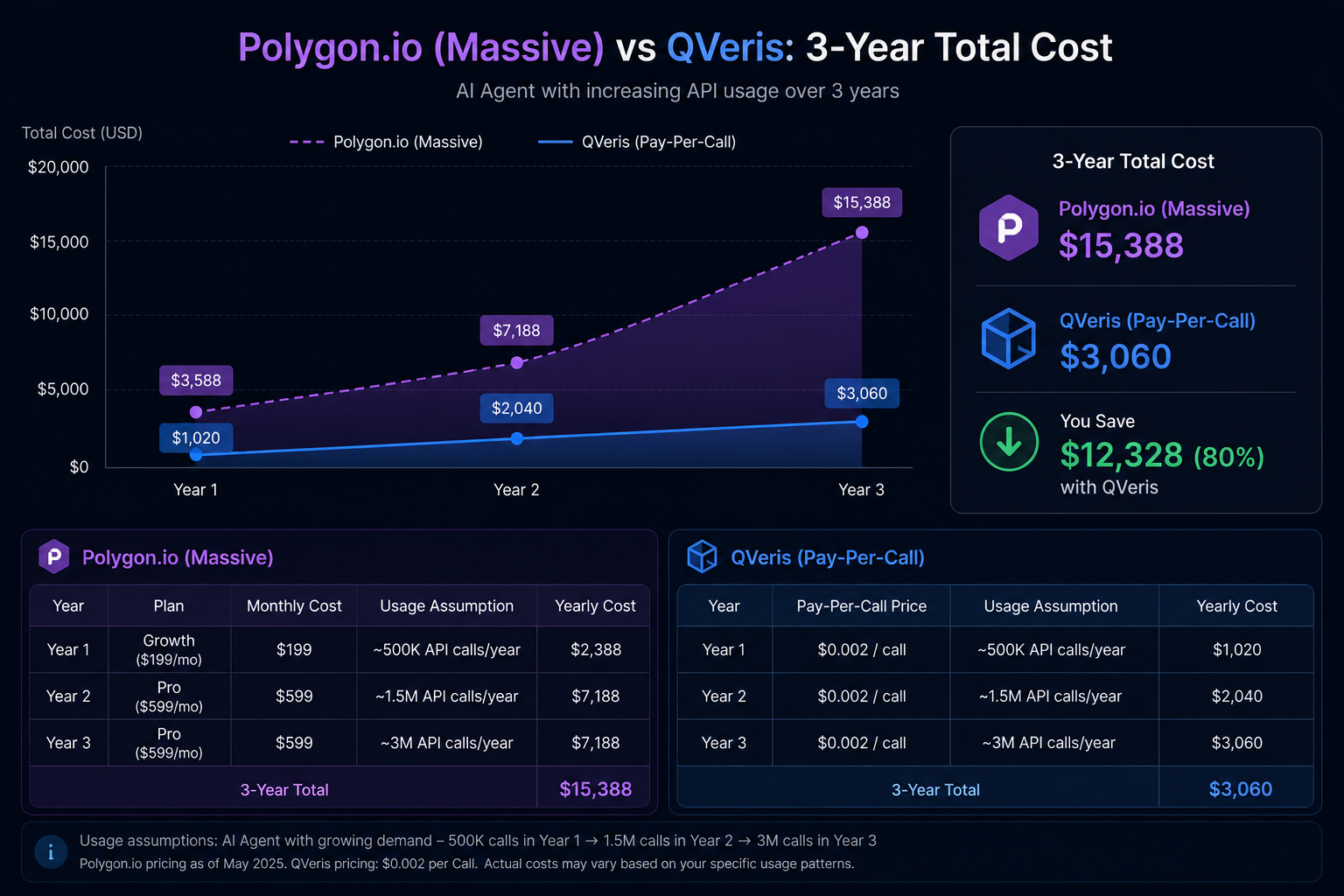
Total Cost of Ownership: Polygon Pricing vs QVeris (3-Year Projection)
Comparing Polygon pricing against QVeris requires understanding their fundamentally different pricing models. Polygon (now Massive) uses fixed monthly subscriptions. QVeris uses a credit-based pay-per-call system with no monthly commitment. Below are realistic 3-year projections.
Polygon (Massive): 3-Year TCO
- Starter ($29/month): $29 x 12 x 3 = $1,044 over 3 years. Suitable for light testing; limited data coverage (US equities only). (Source: Requestly, polygon.io/pricing. Accessed May 25, 2026.)
- Developer ($99/month): $99 x 12 x 3 = $3,564 over 3 years. Moderate tier for development teams. (Source: Requestly, polygon.io/pricing. Accessed May 25, 2026.)
- All-Access ($399/month): $399 x 12 x 3 = $14,364 over 3 years. Minimum for comprehensive production AI workloads. (Source: Requestly, polygon.io/pricing. Accessed May 25, 2026. Enterprise pricing is unpublished.)
Polygon (Massive) pricing accumulates regardless of actual usage. If your AI Agent makes zero calls in a month, you still pay the full subscription. (Tier pricing data sourced from Requestly API Explorer and polygon.io/pricing, accessed May 25, 2026. Cross-referenced with G2 user reviews for real-world tier adoption patterns.)
QVeris: 3-Year TCO
- Development (1-3 months): $0 — Free tier includes 1,000 signup credits + 100 daily login credits, sufficient for prototyping and evaluation.
- Production (1,000 calls/day, avg 5 credits/call): ~5,000 credits/day. At Pro plan ($19/10,000 credits) blended with Scale: approximately $9-$19/month equivalent, since credits never expire and can be purchased on demand. 3-year cost: ~$340-$680
- Production (10,000 calls/day, avg 5 credits/call): ~50,000 credits/day. At Scale pricing ($100/52,500 credits incl. 5% bonus): ~$95/month equivalent. 3-year cost: ~$3,420
Sensitivity Analysis: QVeris TCO Under Different Credit Assumptions
The 5 credits/call average used above is an estimate. Actual credit consumption per call ranges from 1–100 credits depending on capability complexity (per qveris.ai/pricing). The table below shows how QVeris 3-year TCO changes under different per-call credit scenarios.
| Credit Consumption | Credits/Day @ 1K calls | Monthly Cost (est.) | 3-Year TCO | vs Polygon Developer ($3,564) |
|---|---|---|---|---|
| Low (1 credit/call) | 1,000 | ~$2 | ~$72 | -$3,492 |
| Base (5 credits/call) | 5,000 | ~$10 | ~$360 | -$3,204 |
| Moderate (15 credits/call) | 15,000 | ~$29 | ~$1,044 | -$2,520 |
| High (30 credits/call) | 30,000 | ~$57 | ~$2,052 | -$1,512 |
Note: Credits/call vary by capability. Basic stock quotes typically consume fewer credits than complex historical options chains or multi-ticker batch queries. Pro plan credits never expire. Scale volume pricing ($100+/52,500+ credits) would reduce per-credit cost further. All figures approximate. Verify current rates at qveris.ai/pricing.
Real-World Cost Scenarios: When Polygon Pricing Beats Alternatives
Scenario 1: Stock Trading AI Agent Demo (1,000 calls/day)
Polygon (Massive) pricing: Developer tier $99/month minimum for options + crypto data. 3-year cost: $3,564. (Pricing per Requestly API Explorer, accessed May 25, 2026.)
QVeris: $0 development (free tier covers prototyping). Production: ~$9-$19/month at Pro/Scale credit pricing ($19/10,000 credits, avg 5 credits/call). 3-year cost range: ~$170-$1,020 (sensitivity: at 2.5 credits/call ~$170; at 5 credits/call ~$340; at 15 credits/call ~$1,020). (QVeris pricing per qveris.ai/pricing, accessed May 25, 2026. Per-call credit range: 1-100 depending on complexity. Basic stock data typically at lower end.) Potential savings vs Polygon Developer ($3,564): $2,544-$3,394
Scenario 2: Production AI Agent Platform (10,000 calls/day)
Polygon (Massive) pricing: Advanced $199/month or All-Access $399/month for adequate WebSocket capacity. 3-year cost: $7,164-$14,364. (Pricing per Requestly API Explorer. Enterprise cost estimate per G2 enterprise user reports. Both accessed May 25, 2026.)
QVeris: At Scale pricing ($100/52,500 credits incl. 5% bonus, avg 5 credits/call): ~$95/month equivalent. 3-year cost range: ~$1,710-$10,260 (sensitivity: at 2.5 credits/call ~$1,710; at 5 credits/call ~$3,420; at 15 credits/call ~$10,260). (Per qveris.ai/pricing, accessed May 25, 2026.) Potential savings vs Polygon All-Access ($14,364): $4,104-$12,654
Scenario 3: High-Volume AI Agent System (100,000 calls/day)
Polygon (Massive) pricing: Enterprise tier required — custom pricing, typically $1,500-$3,000+/month for high-volume production based on G2 enterprise user reports and third-party analyst estimates. 3-year cost estimate range: $54,000-$108,000+ (Enterprise pricing is unpublished. Range derived from: G2 enterprise user reviews where enterprise accounts report "thousands per month"; CB Insights market-data pricing benchmarks; and industry analyst estimates for equivalent-tier financial API enterprise contracts. This is an estimate only — contact Massive directly for current enterprise pricing.)
QVeris: At Scale volume pricing ($500/302,500 credits incl. 10% bonus, avg 5 credits/call): ~$247/month equivalent. 3-year cost: ~$8,910. (Per qveris.ai/pricing, accessed May 25, 2026. Sensitivity range at 3X credit consumption would be ~$26,730 over 3 years.) Potential savings vs Polygon Enterprise range: $45,090-$99,090
These scenarios illustrate why some teams evaluate Polygon.io alternatives: the fixed-tier Polygon.io API pricing model can become expensive as AI Agent usage grows. QVeris offers a pricing model that scales with actual usage, which may be more predictable for variable workloads. (TCO methodology: 3-year projection at current published rates, assuming no price changes. See Methodology section for full assumptions and limitations.)
Polygon Pricing vs Alpha Vantage Pricing: How They Compare
When evaluating Polygon.io alternatives, Alpha Vantage pricing often comes up as a comparison point. Here is how the Polygon.io API pricing stacks up against Alpha Vantage pricing for AI Agent developers.
| Aspect | Polygon Pricing | Alpha Vantage Pricing | QVeris |
|---|---|---|---|
| Free Tier | None — $29/month minimum | Limited free (5 req/min, 25/day) | Full free discovery + 1,000 signup credits |
| Premium Entry | $29/month (Starter) | $49.99/month (Premium) | $0 (free tier) / $19 (Pro) |
| Billing Model | Fixed monthly subscription | Fixed monthly subscription | Credit-based pay-per-call |
| AI-Agent Native | No | No | Yes |
| Unified Protocol | No | No | Yes (10,000+ capabilities) |
Sources: Alpha Vantage free tier reduced to 25 calls/day (FindMyMoat review 2026). Polygon pricing per Requestly API Explorer. QVeris pricing per qveris.ai/pricing.
Both Polygon (Massive) and Alpha Vantage follow traditional subscription models. For AI Agent developers specifically, neither is designed for variable workloads, free testing, or unified multi-source access. QVeris addresses these gaps with a unified protocol and credit-based pay-per-call model built for AI Agent use cases.
Migrating from Polygon.io to QVeris: A Practical Guide
If you are evaluating QVeris as a Polygon.io alternative for your AI Agent, here is how to approach migration. Many teams find parallel operation during transition minimizes risk.
Step 1: Verify Data Coverage (Free Discovery)
QVeris offers free Discover + Inspect to verify that the data you need is available before committing to migration. This is possible at zero cost on the free tier — unlike Polygon.io, where evaluating data quality typically requires a paid subscription.
Step 2: Compare API Design Patterns
Polygon.io uses traditional REST endpoints and WebSocket connections per data source. QVeris provides a unified protocol: one integration pattern across stocks, options, crypto, and macro data. Teams accustomed to per-endpoint management may need to adjust to the unified approach.
Step 3: Gradual Parallel Operation
Run both systems during transition. QVeris pay-per-call model means no large upfront commitment to switch, and the free tier supports evaluation without financial risk. Many teams maintain Polygon/Massive for existing production paths while building new AI Agent capabilities on QVeris.
Code Comparison: Polygon.io vs QVeris
// Polygon.io approach (traditional API)
const polygon = new PolygonClient('YOUR_API_KEY');
const stockData = await polygon.stocks.ticker('AAPL').results();

// QVeris unified protocol (AI-Agent native)
const qveris = new QVerisClient('YOUR_API_KEY');
const stockData = await qveris.call('get_stock_quote', {symbol: 'AAPL'});
// Same interface works for options, crypto, macro data
const cryptoData = await qveris.call('get_crypto_price', {symbol: 'BTC'});
The unified protocol approach can simplify AI Agent development. Instead of learning separate endpoints for each data source, QVeris provides consistent interfaces across stocks, options, crypto, and macro data.
Decision Framework: Is QVeris the Right Polygon.io Alternative for You?
If you are looking for a Polygon.io alternative, consider these decision criteria:
- Choose QVeris if: Building AI Agents, need free development/testing, have variable call volumes, want unified protocol for multiple data sources, or are currently evaluating Polygon.io pricing as too expensive.
- Stick with Polygon.io if: Already deeply integrated with Polygon.io, only need US equity data, have stable predictable high-volume needs, and the fixed tier pricing model fits your budget.
- Consider both (hybrid): Many teams use QVeris for AI Agent development and new features, while maintaining Polygon.io for specific high-volume production use cases already optimized.
Quick Start: Evaluate QVeris Alongside Your Current Setup
Register at qveris.ai, no credit card required. Use free Inspect to verify whether QVeris covers your specific data needs.
Run QVeris alongside your existing Polygon.io/Massive integration. Compare data coverage, response times, and integration effort without disrupting production.
If QVeris meets your requirements, migrate gradually. Pay-per-call pricing means you only pay for what you use — no upfront subscription commitment.
Try QVeris Free — No Commitment Required
Free tier (1,000 signup + 100 daily credits) for evaluating capabilities. Compare against your current Polygon/Massive setup at zero cost.
Try Free →